The Books Nobody Told You About Are Often the Ones That Change You
There's a specific kind of reading experience that almost every devoted reader can describe but almost nobody talks about publicly. It goes like this: you find a book through some completely random channel — a stranger's offhand recommendation, a dusty shelf at an estate sale, a weird algorithmic misfire that somehow nailed it — and you read it, and it quietly rearranges something in you. And then you look it up online and find 47 ratings and a Wikipedia stub.
That experience — the off-the-radar find that hits harder than anything on the bestseller list — is one of the most underrated pleasures in reading. And it's getting harder to stumble into, which is exactly why it's worth chasing more deliberately.
Why Obscure Books Get Buried
The publishing industry, for all the brilliant people working in it, operates on a model that concentrates attention. Marketing budgets flow toward books with the best projected returns. Algorithms — on Amazon, on Goodreads, on TikTok — amplify what's already performing well. Reviewers at major outlets cover what they're pitched, and what they're pitched is what publishers are spending money to promote.
The result is a kind of gravitational pull toward the same books. Not necessarily the best books. The most visible books. And visibility in publishing has a lot more to do with timing, connections, marketing spend, and cultural moment than it does with quality of prose or depth of storytelling.
This means that every single year, books of genuine, sometimes extraordinary merit get published and quietly disappear. Not because they weren't good. Because nobody had the budget or the platform to make them loud.
The Cult Classic Pipeline
Some of those buried books eventually find their audience. Not through marketing campaigns, but through the slow, organic spread of readers telling other readers. This is how cult classics are made.
Think about how many beloved books spent years — sometimes decades — in relative obscurity before a single influential mention tipped them into broader awareness. Stoner by John Williams was published in 1965, got modest reviews, and then basically vanished. It was rediscovered in Europe in the 2000s and eventually found its American audience almost fifty years after publication. It's now considered one of the finest American novels of the twentieth century.
That's an extreme case, but the pattern plays out constantly at smaller scales. A book that's been quietly passed between readers for five years suddenly gets mentioned in one newsletter, or featured in one BookTok video from an account with real reach, and overnight it's everywhere. The book didn't change. The attention did.
What this means for you as a reader: the books that will matter most to you personally might already exist. They might be sitting in a database somewhere with a handful of ratings and no reviews from anyone you've heard of. The question is how to find them.
Why Under-the-Radar Books Hit Different
There's a psychological component to this that's worth acknowledging. When you read a heavily hyped book, you bring expectations. You've read the reviews, you've seen the discourse, you have a rough sense of how you're supposed to feel. Even if you love it, you're partly confirming an existing narrative.
When you read a book nobody told you about, you bring nothing. You're encountering it completely fresh. There's no social proof to lean on, no community reaction to align yourself with. It's just you and the text, and whatever happens between you happens on its own terms.
That's a more vulnerable reading experience in some ways. But it's also a more honest one. The books that find you in that unguarded state tend to stick differently.
Practical Ways to Find What the Algorithm Misses
The good news is that finding overlooked books is a learnable skill. A few strategies that actually work:
Follow readers, not influencers. There's a difference between someone who makes content about books and someone who just reads obsessively and occasionally shares what they're into. The latter is often a better source of genuine discoveries. Look for readers with niche, specific taste rather than broad appeal.
Mine the acknowledgments. Authors thank the books that influenced them. Flip to the back of a book you love and start pulling threads. This is one of the most underused discovery tools in existence.
Explore small presses deliberately. Publishers like Graywolf, Restless Books, Two Dollar Radio, and Soho Press consistently put out work that doesn't get mainstream attention but punches well above its weight. Browsing their catalogs directly — not through Amazon's recommendation engine — turns up things you'd never find otherwise.
Ask for the books nobody bought. Indie booksellers are genuinely great at this. Tell them you want something they love that nobody's been asking for. You will walk out with something weird and wonderful almost every time.
Use AI recommendations with specific prompts. Generic prompts get generic results. But when you give BookSurf AI something specific — a feeling you're chasing, an obscure book you already loved, a very particular emotional need — it can surface titles that would never make a bestseller list but might be exactly what you're looking for. The more specific you are, the further off the beaten path you can get.
Check library hold lists — in reverse. If a book has a 200-person hold list at your local library, it's not hidden. But if you're browsing the stacks and something with a 1993 spine and a hand-typed label catches your eye? That's the one.
Celebrating the Find
There's something genuinely thrilling about reading a book that feels like it was waiting specifically for you — not because it was engineered for your demographic or optimized for your reading history, but because by some combination of luck and instinct, you found each other.
Those books are out there. A lot of them. They don't have cover stories or podcast tours or celebrity endorsements. They have pages, and they have the readers who find them.
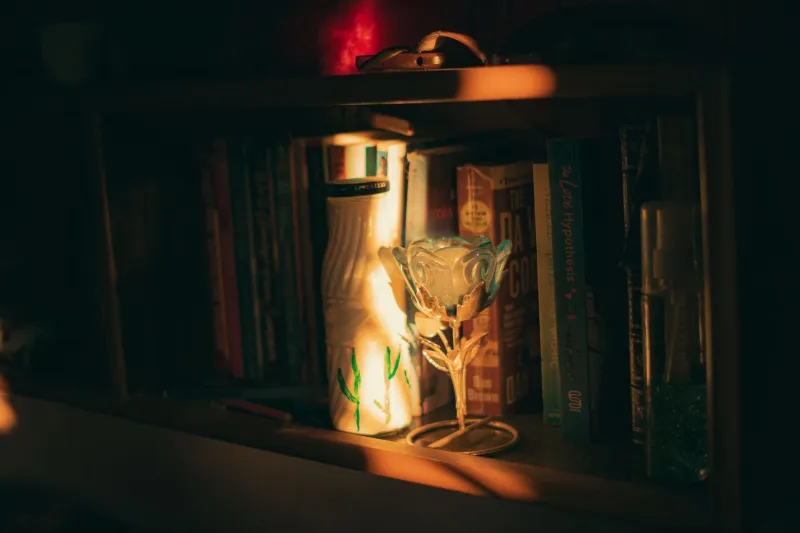
The bestseller list will always tell you what everyone else is reading. But the books that glow in the dark — the ones that quietly light up something in you that nothing louder ever could — those are found in the margins. In the overlooked corners. In the recommendations that come from left field and land exactly right.
Sometimes the best wave isn't the one everyone's paddling toward. It's the one breaking quietly just around the bend, waiting for the reader paying close enough attention to catch it.